
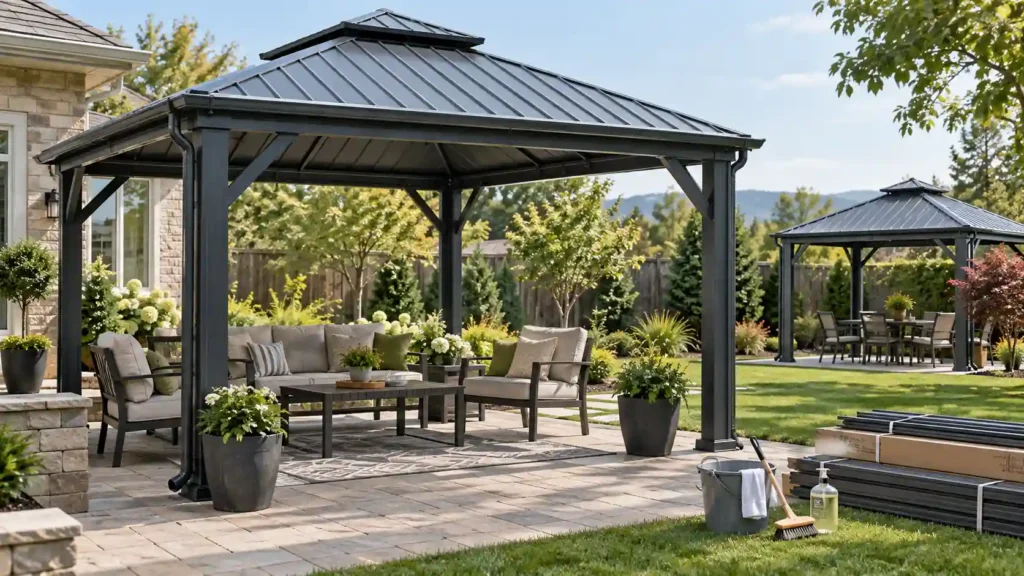
A metal gazebo can turn an open patio into a handy outdoor room. It can shade a table or cover a grill. It can also give you a quiet place to sit. The best choice is not always the largest model or the lowest price. The frame, roof, base, and local weather all matter.
This guide explains the main types of metal gazebos. It compares steel and aluminum. It covers metal roof styles, common sizes, kits, grill shelters, spare parts, and care. It also covers wood frames. They may work better with a metal roof.
Quick answer
A good metal gazebo should have:
- A frame and roof rated for wind and snow in your area.
- A level base and anchors that match the base type.
- A finish that suits your climate, such as powder coat or a zinc coat.
- A roof slope, gutter plan, and drainage path that keep water away from the posts.
- Enough clear space for people, furniture, and safe grill use.
- A manual, parts list, and cover terms that you can still access after purchase.
Steel is often strong and cost friendly. Aluminum is light and does not form red iron rust. Both can fail when the joints, anchors, or roof load are ignored. Read the load label and your local rules before you order.
What counts as a metal gazebo?
A metal gazebo has a steel, aluminum, or iron frame. It may use one metal or a mix. Many models also have a metal roof. Others use a fabric, clear plastic, or vinyl cover on a metal frame.
The terms can be hard to sort. A metal roof gazebo often describes the roof. So does metal-top gazebo. The phrase gazebo with a metal roof can mean the same thing. These names do not tell you about the posts. A metal frame gazebo may have a soft cover. A wood gazebo with a metal roof has timber posts and beams. Its roof is metal. A metal gazebo with a metal roof is the most fixed form. Its base and anchors need close care.
In Spanish, gazebos en metal and gazebo de metal mean metal gazebos. The same checks apply in any language. Confirm the parts, the load rating, the base, and the care guide.
Steel or aluminum: which metal is better?
Start with the metal type. A black finish does not prove that the unit is steel. It may use a light alloy or a mix of metals.
| Frame type | Main strengths | Points to check |
|---|---|---|
| Powder-coated steel | Firm feel, good stiffness, and many style choices | A chip can expose steel to rust. The frame is heavy to move. |
| Galvanized steel | Zinc coating helps shield the steel from rust | Cut edges, scratches, and trapped water still need care. Use the maker’s touch-up method. |
| Aluminum | Light weight and good resistance to red iron rust | It can dent more easily. Thin parts need good bracing and anchors. |
| Wrought iron or solid iron | Classic look and strong ornate parts | It is heavy and needs paint care. Rust at joints can weaken it. |
| Mixed metal | Can balance weight, cost, and strength | Dissimilar metals can corrode when water and salt bridge the joint. Use the supplied fasteners. |
Powder-coated steel
Powder coating is a tough finish, but it is not armor. A cut edge, deep scratch, or loose screw can start rust. Do not scrub a coated frame with a rough pad. Wash it with mild soap and water. Touch up small damage with a product approved for that coat.
Galvanized steel
Galvanizing puts a zinc layer on steel. That layer can shield the base metal for a long time. It still needs a check. Do not paint over dirt, oil, or damp rust. Follow the coat maker’s repair method when a bare spot appears.
Aluminum
Aluminum does not rust like steel because it contains no iron. It can still pit or corrode. Salt, wet leaves, harsh cleaners, and contact with other metals can mark the surface. Rinse a coastal or poolside unit more often. Make sure the screws are made for the frame.
Choosing a metal roof for a gazebo
A roof does more than block rain. It adds weight, catches wind, sheds snow, and affects heat and sound below.
Ribbed or corrugated metal panels
These panels are common in metal gazebo roof kits. The ribs add stiffness and help water run toward the edge. Panel shape, joint, screws, and closure strips must match. Never mix a panel from a new profile just because it looks close.
Flat-seam or standing-seam panels
Some high-end hardtop models use clean, low-profile seams. They can look more like a small house roof. They still need the right slope and edge flashing. A neat seam is not a new roof system.
Aluminum roof panels
Aluminum keeps the roof light. That can help with the build and reduce the load on a light frame. It may dent from hail or a falling branch. Ask how the panel is held and how the finish should be fixed.
Metal frame with a non-metal cover
An outdoor metal gazebo may use a fabric or clear plastic top. It can be easy to move and may cost less. A hard metal roof gives a firm barrier against rain and snow. It can also get hot and loud. Check the cover’s take-off and storage rules before winter.
Roof features worth paying for
Look for a stated roof load and tested wind rating. Roof vents, gutters, and a clear water path also help. A double-tier vent can let hot air out. A gutter can protect the slab and stop splash at the posts. A roof edge can keep rain off curtains and chairs.
Do not guess a roof’s snow limit from its thickness. The International Building Code uses local ground snow data and other design factors. Your model must suit your site. The guide and local building office are the right places to check this.
Choose the right gazebo size
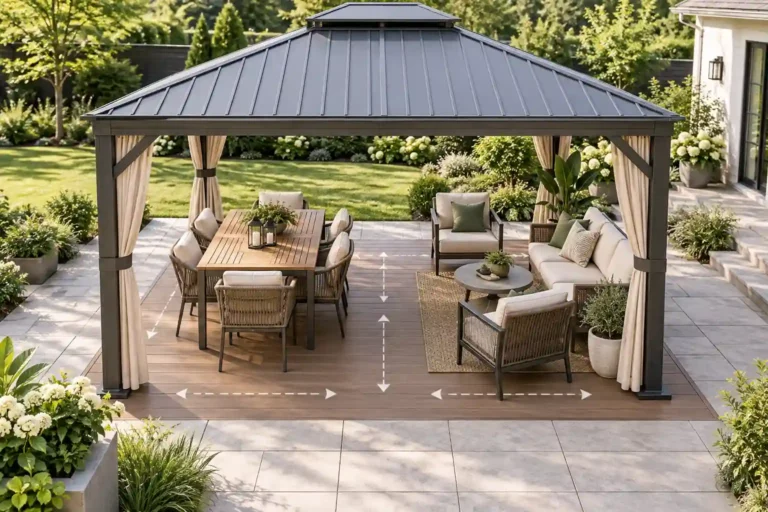
Listed size is measured at the outside of the frame. Posts and braces reduce the clear floor area. The roof edge can also make the footprint larger than the floor.
| Common size | Approximate floor area | Good starting use |
|---|---|---|
| 8×8 | 64 square feet | Two chairs, a small table, or a compact garden nook |
| 10×10 | 100 square feet | A four-person table, lounge chairs, or a small grill zone |
| 10×12 | 120 square feet | A dining set with room to walk around it |
| 12×12 | 144 square feet | Six-person seating, a fire table approved for outdoor use, or a larger grill area |
| 12×14 | 168 square feet | A dining and lounge layout with a clear path |
| 12×16 | 192 square feet | An outdoor kitchen, large table, or screened sitting room |
| 10×20 | 200 square feet | A long patio room, party table, or divided cooking and seating zones |
For a 10×10 metal gazebo, mark a ten-foot square before you buy. Stores may write the same size as 10 x 10 metal gazebo. They may also use metal gazebo 10×10 or 10 by 10 metal gazebo. Add space for the roof edge, steps, and a path. Use the same check for a 10×12 or 12×12 model. A tape measure can stop a costly return.
A listing for a 10 x 12 metal roof gazebo, 10×12 metal gazebo, or 10×12 gazebo metal roof should show the same basic footprint. The same rule applies to a 12 x 12 metal roof gazebo and a 12×12 gazebo with metal roof. Check the drawing. Do not trust the title alone.
A small 8×8 or 8×10 unit may suit a narrow yard. A 10×14 or 12×16 model needs a larger base and more people for the build. Do not squeeze a large roof between a house and a fence. Wind can speed up in a tight gap.
Some stores reverse the words in the title. You may see 8×10 gazebo with metal roof, 10 x 14 gazebo metal roof, or 12×16 gazebo with metal roof. Treat these as size labels. Then read the drawing and load data. A long 10×20 gazebo metal roof needs care at the anchors. It also needs a clear plan for roof water.
Match the style to the way you will use it
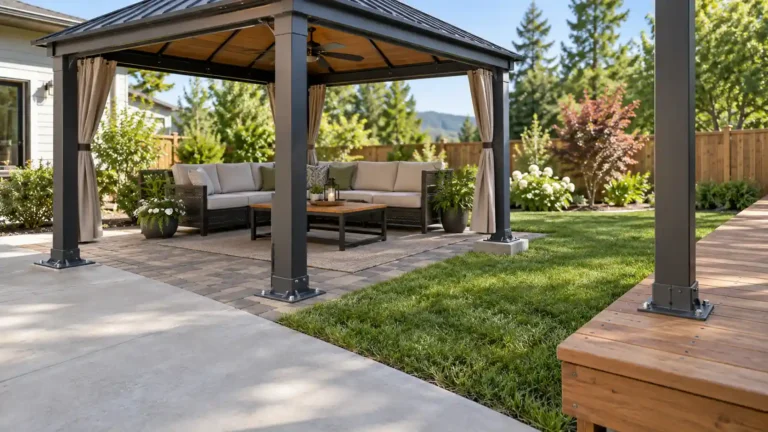
A metal patio gazebo is made for chairs, meals, and foot traffic. A metal garden gazebo may be smaller and may frame plants or a path. An outdoor metal gazebo can serve both roles. The base must be level, and the roof must drain away from the beds.
Metal hardtop gazebo
A metal hardtop gazebo has a fixed roof and firm posts. It feels more like a room. It is a strong choice for a dining area or covered patio. It also needs a sound base and care at the anchors.
Grill gazebo
A grill gazebo protects a cooking station from sun and light rain. Look for a metal roof grill gazebo with open sides and good airflow. The roof height must suit the grill maker’s rules. Keep curtains, fabric, and plants away from heat. Never use a charcoal or gas grill under a closed cover. Follow both makers and local fire rules.
The word metal grill gazebo can mean a small roof over a grill. It can also mean a full patio shelter with a built-in counter. Check the clear cooking space, vent height, and shelf layout. A cheap roof is not a bargain if heat damages its finish.
Screened metal gazebo
A metal screened gazebo can keep insects out while still letting air move. Check how the screen panels attach. Zippers and hook-and-loop strips are easy to replace. A screen room is not a storm shelter. Remove or secure panels when the guide calls for it.
A metal gazebo canopy may be a soft top, a rain cover, or side panels. A metal gazebo with canopy is not the same as a hardtop model. Ask how the cover is tied down. Ask when it must be removed.
Round or circular metal gazebo
Round and eight-sided models soften a garden or pool area. They can be harder to furnish because square tables leave unused corners. Measure the clear width, not just the outside roof size. A round metal gazebo still needs anchors at each point named in the guide.
Lean-to gazebo with a metal roof
A lean-to can attach to a house or stand beside it. The ledger, flashing, and wall link need extra care. Do not attach a kit to siding without a method approved for that wall. If the plan changes the house roof or drain path, ask a trained builder to review it.
Wood posts with a metal roof
A cedar gazebo with a metal roof can give you a warm wood look and a hard roof. Wood posts need a dry base, end-grain care, and finish checks. Metal roofing can outlast a weak wood joint. Inspect the whole system. For wood care, see our guide on how often to seal or stain a wooden gazebo.
What should a metal gazebo kit include?
Most metal gazebo kits include posts, beams, roof panels, brackets, screws, and a build guide. Some kits leave out the anchors, concrete, pavers, curtains, screens, or gutter parts.
Before you pay, check for:
- A full parts list with part numbers.
- A roof plan that shows panel order and joints.
- Anchor hardware for your base type, or clear anchor specs.
- New roof panels and screws that can still be ordered.
- A finish cover and a frame cover with clear terms.
- A guide for snow, wind, roof cleaning, and cover removal.
- A support phone number or service page that works in your country.
- A box weight and package count that your delivery team can handle.
Metal roofed gazebo kits often ship in long, sharp boxes. Keep the boxes dry. Count parts before you build. Take photos of labels and store the guide in a dry file. A kit sold as gazebo kits with metal roof should list the same roof parts and screws as the full model.
How to compare metal gazebos for sale
Online listings may use the same words for very different products. Compare the specs, not the thumbnail.
Check the frame metal, post size, roof type, roof load, and wind rating. Check the finish, anchor method, cover terms, and parts support too. Then check the clearance terms. A clearance metal gazebo may be a good deal when all parts are sealed and the return window is clear. It is risky when the box is open or the roof is gone. Spare parts may be hard to find. A listing called metal gazebo clearance or metal roof gazebo clearance still needs the same parts check.
Ask these questions before buying:
- Is the listed size the floor size or the roof size?
- Does the roof rating apply to the full kit or only the panels?
- Are snow and wind ratings tested for the assembled unit?
- Are curtains, screens, and gutters included?
- Can I buy a metal gazebo roof replacement later?
- Does the kit require a concrete slab?
- Which screws and touch-up products are approved?
- Does my town require a permit or setback review?
Color is a style choice. A black metal gazebo can look sharp. A dark roof may feel warmer in full sun. Place shade cloth or curtains only when they are made for the kit. Do not block needed air flow.
Prepare the base before assembly
The base carries the frame. It also controls drainage and door fit.
- Measure the full footprint, with the roof edge.
- Mark property lines, utility routes, trees, and service access.
- Confirm local permits, setbacks, and height limits.
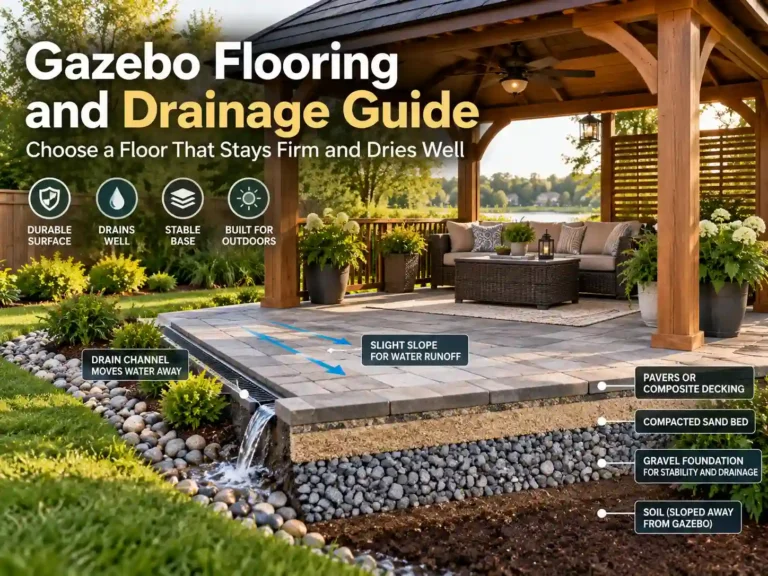
- Use a firm, level base that matches the manual.
- Plan where roof water will drain.
- Keep the base above areas that pond after rain.
- Have the correct anchors ready before the frame goes up.
Pavers over loose soil may shift. A slab may need extra support or a drain edge. Do not drill into a post-tensioned slab without knowing where the cables are. Ask a local pro when the base or wall link is unsure.
Assemble a metal gazebo safely
Read the guide from start to finish before you open each bag. Build on a calm, dry day.
- Use at least two adults for long beams and roof panels.
- Wear gloves and eye protection when handling cut metal edges.
- Keep children and pets out of the work zone.
- Use the supplied screws in the stated spots.
- Keep posts plumb and the frame square before the last turn.
- Do not climb on a roof panel unless the maker states that it is walkable.
- Do not cut, drill, or seal a panel unless the guide calls for it.
- Install each brace and anchor before adding curtains or chairs.
If the frame rocks after you add the anchors, stop. Do not hide a shift with extra sealant or a loose shim. Find the cause. A moving base can enlarge bolt holes and bend the roof over time. A DIY metal roof gazebo still needs the same base and load checks as a pro-built unit.
Maintain the frame and roof
Metal needs less finish work than wood, but it is not care free. A short check each month can catch a loose screw or blocked drain. Our complete gazebo maintenance checklist by season and material gives you a simple year-round routine.
Clean without harming the finish
Remove leaves and grit with a soft brush. Wash with mild soap and a soft cloth or sponge. Rinse with a gentle hose spray. Let the roof dry before you inspect seams and screws.
Avoid rough pads, strong solvents, and pressure washing unless the maker allows them. Water forced under a lap or into a light can create a leak. See our guide on how to clean a gazebo roof without damaging it for steps by roof type.
Stop rust early
Look at cut edges, screw heads, welds, post bases, and places where leaves stay wet. Surface rust may be fixable. Deep pits, holes, cracked welds, and loose bases need a part check.
Do not paint over damp rust. Do not grind a thin roof panel. Our guide on how to remove and prevent rust on a metal gazebo explains when a touch-up is safe. It also tells you when replacement is wiser.
Check the roof after storms
Inspect from the ground after strong wind, hail, heavy rain, or snow. Look for lifted panels, bent flashing, open seams, blocked gutters, and shifted anchors. Keep people away from a roof that sags, creaks, or has loose metal.
If water appears below the roof, mark the drip and inspect only when the weather is dry. Water can travel along a beam. The drip point may not be the entry point. Use our guide on how to fix a leaking gazebo roof before you apply any sealant.
Replacement parts and roof repairs
Buy parts by model number, not by looks. A roof panel that is one inch wider can change the joint. A screw with the wrong washer can leak or crush the panel.
| Sign | Possible action |
|---|---|
| Loose screw with a sound hole | Replace with the maker’s approved fastener and washer. |
| Chipped paint on firm steel | Clean, dry, prime, and touch up with the right product. |
| Small dent away from a seam | Ask the maker if the panel can stay in service. |
| Open seam or missing closure | Refit the correct part before sealing. |
| Deep rust, a hole, or a thin panel | Replace the panel or call a trained pro. |
| Bent post, cracked weld, or moving anchor | Stop use and arrange a frame check. |
| Torn canopy or screen | Use the right new cover or panel. |
Metal gazebo frame replacement parts are often sold as spare parts. They may include brackets, corner caps, braces, posts, screws, and feet. Record the model number before you take out any part. Keep one old part until the new part fits.
Is a metal gazebo right for your yard?
Choose metal when you want a firm frame and a fixed roof. It also gives a clean look with little finish work. Steel may suit a tight budget or a snow-prone site when the kit has a proper rating. A light alloy may suit a small yard, a deck, or a site where you may need to move the unit.
Choose wood when you want easy field changes or a warm look. It can match an old deck. A wood frame can still use a metal roof. Choose a canopy when you need a light, part-year shelter. Store the cover in bad weather.
No metal wins every test. The right shelter is the one that fits your base, climate, use, and care time.
Frequently asked questions
Do metal gazebos rust?
Steel can rust when water reaches bare metal. Powder coat and galvanizing slow the process. Aluminum has no iron, so it does not form red rust. It can still pit. Clean salt and dirt, fix chips early, and keep water from pooling at the base.
Is a metal roof better than a fabric roof?
A metal roof is often firmer and lasts longer in daily use. It can also be hotter, louder in rain, and heavy. A fabric roof is light and easy to remove. It needs more care in wind, snow, and sun. Match the roof to your climate and use.
What is the best size for a grill?
Start with the grill maker’s clear space. Add room to open the lid and move around the sides. Keep fuel or heat away from curtains. A 10×10 grill gazebo can work for a small station. A 10×12 or 12×12 gives more working room. Never use the footprint alone to judge fire risk.
Can I put a metal roof on an existing gazebo?
Sometimes, but the frame must carry the new weight and wind force. The roof slope, rafters, flashing, and anchors must also suit the panels. Do not swap a roof by guesswork. Have the maker or a trained builder confirm the plan.
Are 10×10 and 10 x 10 gazebos the same size?
Yes. The spacing is only a search and writing style gap. Confirm whether the seller means the floor, frame, or roof size. The clear area inside will be smaller than the listed outside size.
What does “metal top gazebo” mean?
It often means a gazebo with a metal roof. The posts may be steel, aluminum, or wood. Read the frame and roof specs apart.
Can I install a metal gazebo myself?
Many kits are made for safe DIY work. You still need a level base, two or more adults, safe lifting, and the right anchors. Hire help for a wall tie-in, roof access, frame change, or power work.
Do I need a permit?
Rules vary by town and by structure size. Setbacks, height, base type, power work, and a tie to a house can change the answer. Ask your local building office before you buy or dig.
Conclusion
Choosing a metal gazebo is about more than size or appearance. Match the frame, roof, anchors, and base to your yard and local weather. Check the snow and wind rating before you buy.
After installation, keep the roof clear and the frame clean. Check the screws, seams, drains, and post bases through the year. Fix small damage early, and get help when the structure moves, bends, or shows deep rust. Good care will help your gazebo stay safe, useful, and attractive for many seasons.

One thought on “Metal Gazebos: A Practical Guide to Metal Roofs, Sizes, Kits, and Care”