
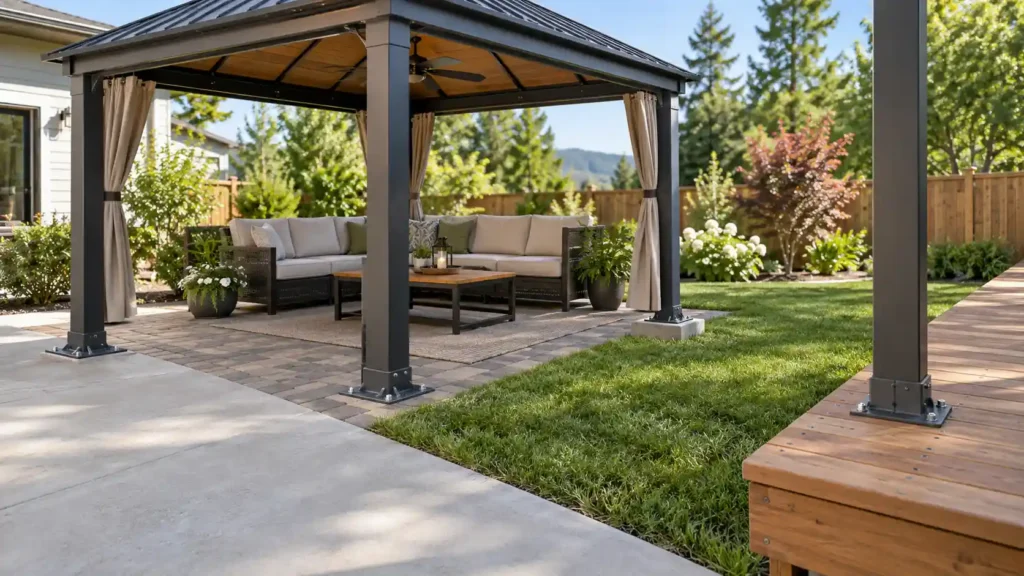
A gazebo can feel firm on a calm day yet shift when a gust gets under its roof. One loose paving block, a shallow anchor, or a weak deck board can put the whole frame at risk.
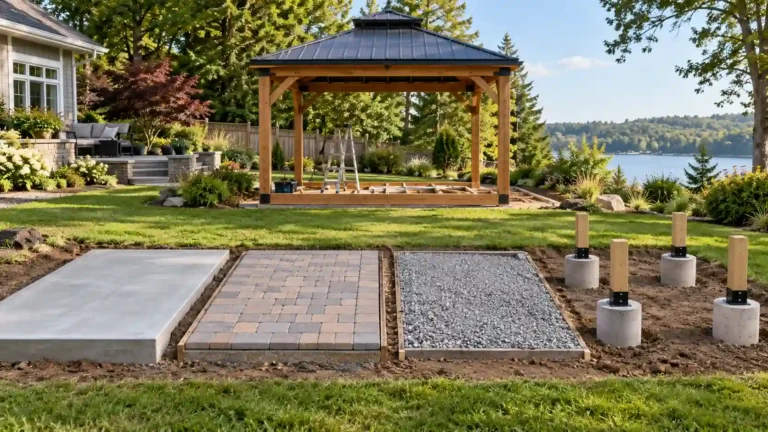
The right fix starts below each post. Concrete needs anchors suited to the slab. A paver patio often needs separate footings. Grass calls for different methods based on whether the gazebo is fixed or portable. On a deck, the connection must reach a frame built to take the load.
Get those details right before you drill. You will avoid wasted holes and give your gazebo a sound base for years of use.
Which Anchoring Method Fits Your Surface?
| Surface | Suitable approach | Main point to check |
|---|---|---|
| Concrete | Specified concrete anchors fixed through the post bases | Slab strength, thickness, anchor depth, and edge clearance |
| Pavers | Post bases fixed to designed concrete supports beneath or within the patio | Loose paving blocks must not act as the sole anchor |
| Grass, permanent gazebo | Designed concrete footings or an approved ground screw or pile system | Soil, frost, wind loads, and post support |
| Grass, portable gazebo | The model’s specified stakes, ropes, and any required weights | Soil grip and the shelter’s weather limits |
| Wood or composite deck | Designed connections to sound framing below the boards | The full deck must support the added roof and wind loads |
For a permanent gazebo, the anchor must connect the post to a support that can resist the design loads. A tidy patio surface alone does not prove that it can do that job.
If you are still choosing a base, start with our gazebo foundation comparison.
Before You Buy Anchors
Find the instructions for your exact gazebo model. The roof size on the box may differ from the spacing between the posts. Use the post layout drawing to mark the site.
Check whether the kit includes ground anchors or just the bolts used to build the frame. Even supplied anchors may suit only one base. For example, Canopia’s Milano manual limits its supplied masonry fixings to concrete. It calls for advice on the right fasteners for other surfaces.
Confirm the following before work starts:
- The post positions and base plate hole pattern.
- The approved foundation and anchor details.
- Any local permit, footing, wind, and snow requirements.
- Whether the surface is sound and drains well.
- Whether pipes, wires, or other buried services cross the work area.
In the United States, contact 811 before digging. Wait for all responses and follow the instructions on your ticket. That applies when preparing ground anchor and footing locations as well as larger excavations. The 811 guide explains the process. Private yard wiring and irrigation may need a separate locate.
Work in calm weather. Follow the kit’s assembly and bracing sequence, and secure the structure at the stated stage. A partly built gazebo must not be left where wind can catch it.
Tools to Have Ready
Most jobs need a tape measure, level, marker, sockets, and the specified anchor hardware. Concrete work may also need a hammer drill, masonry bits, hole-cleaning tools, and a torque wrench.
Wear eye and hearing protection for drilling. Use dust control suited to concrete drilling and the tool instructions. When handling wet concrete, wear waterproof gloves and keep it off your skin.
How to Anchor a Gazebo on Concrete
A sound concrete base can provide a direct fixing point. First, confirm that the slab was built well enough for the gazebo and its anchors. A patio made to carry chairs may need extra work before it can hold down a roof.
1. Check the Slab and the Anchor Plan
Look for crumbling edges, uneven sections, and damage near the proposed posts. A visual check helps find defects, but it cannot confirm the slab’s thickness or strength.
Check the slab records where available. If its construction is unknown, have it assessed before choosing anchors. Do not drill into a post-tensioned slab without a qualified review and a clear drilling plan. Hidden cables and pipes also need to be located.
Choose anchors based on the approved connection details. Concrete screw anchors, wedge anchors, and bonded threaded rods work in different ways. Each has its own limits and fitting steps.
Do not choose an anchor just because it fits the base plate hole.
2. Mark the Exact Post Positions
Lay out the base plates using the kit drawing. For a square or rectangular layout, check both diagonal measurements as well as the side lengths.
Check each proposed hole against the anchor’s required spacing and distance from the slab edge. Include joints and damaged areas in that review. A plate may fit on the patio while its holes sit too close to an edge.
Resolve that problem before drilling. Moving the whole layout or changing the support design may be needed.
3. Drill and Prepare the Holes
Use the bit size and hole depth stated for the exact anchor. Keep the drill straight. Do not rock it to enlarge a tight hole.
Follow the required cleaning process. Some systems call for brushing and blowing out dust; others use a specified dust extraction method. Use the method listed for your anchor.
Hole depth and anchor embedment are different measurements. Embedment is the depth the anchor engages in the concrete. The base plate, washers, and any approved spacers also affect the total anchor length.
4. Fit and Tighten the Anchors
Install each fixing in the order shown in its instructions. Use the required tightening method. A wedge anchor may need a set torque, while a concrete screw has its own seating rules.
If using a bonded anchor system, follow its hole preparation, temperature, and curing requirements. Do not load it before the stated cure is complete.
Use the specified number of anchors at each base. Do not add holes to the plate or skip required holes to work around a poor fit.
5. Check the Finished Bases
Each base should bear on its designed support without rocking. Use only approved leveling details; loose wood scraps are not a lasting fix.
Keep drainage routes open around the posts. Save the anchor model, installation details, and photos for future checks.
Stop if an anchor spins, the concrete breaks away, or a base will not seat correctly. More force is not a repair for a damaged hole.
How to Anchor a Gazebo on Pavers
Most pavers sit on sand or a prepared stone base. A bolt fixed into one loose block ties the gazebo to that block. Wind may lift both together.
For a fixed gazebo, a common solution is to create concrete supports at the post locations. Canopia’s Milano foundation guidance shows concrete supports for paving stone installations and tells owners to check footing depth in freezing areas.
1. Map the Posts Before Lifting Pavers
Mark the exact post centers and plate positions. Take a photo of the paving pattern so you can restore it later.
Plan the finished support height at the same time. The post base needs firm bearing, and water should drain away from it.
2. Lift the Pavers at Each Support Point
Remove enough paving to build the specified support. Keep whole blocks aside where possible.
Check what lies below. Sand, gravel, and an existing concrete slab need different approaches. Do not assume a layer of concrete is thick enough or strong enough for anchors.
3. Build the Specified Footings
Use the foundation dimensions set for the gazebo, soil, and local conditions. A small concrete plug poured around a post is not a universal footing design.
Where frost protection is required, account for it in the depth or approved foundation system. QUIKRETE notes that footing width and depth depend on local requirements, and footings typically extend below the frost line.
Let the concrete reach the strength required for the chosen anchors and loads.
4. Fix the Bases and Restore the Patio
Anchor the posts using the approved support detail. Replace or cut pavers around the bases as needed. Keep parts that need inspection accessible.
Avoid using long bolts to bridge loose sand, empty space, or unsupported paving. Reaching concrete is only part of the job; the base also needs a sound path to transfer its load.
If your paving sits over a suitable structural slab, a fixing through that finish may be possible. Have the connection detailed for the full build-up before drilling.
How to Anchor a Gazebo on Grass
Choose the method based on the gazebo’s intended use. A portable shelter for a family lunch and a fixed hardtop gazebo need different support plans.
For a Portable Gazebo
Use the stakes, guy ropes, and weights required for that model. Guy ropes are the lines that run from the shelter’s approved tie points to ground anchors.
- Pick firm, level ground with room for all tie-downs.
- Check buried services before driving stakes or screw anchors.
- Fit each anchor at the depth and angle stated for that system.
- Attach ropes or straps only to the intended fixing points.
- Adjust the tension evenly without bending the frame.
- Keep lines clear of paths and check them during use.
Stake designs vary. E-Z UP, for instance, sells a system that pins stakes to compatible shelter legs. That differs from a rope tied to a separate peg, so follow the instructions for your own kit. See the E-Z UP stake system.
Soft, wet, or disturbed soil may provide less grip. If a stake will not hold, move to a suitable spot or use an approved alternative.
Take the shelter down before weather exceeds its limits. Extra weights do not turn a light canopy into a permanent storm shelter.
For a Permanent Gazebo
Use foundations designed for the site. Concrete footings beneath the posts are one option. An engineered ground screw or helical pile system may also work where its design and local requirements allow it.
Structural ground screws are different from small lawn stakes. Their suitability depends on the soil, loads, installation, and post connections.
Plan drainage and finished ground levels so soil and mulch do not bury the bases. Keep wood posts off wet ground using the support detail specified for the structure.
A grass floor can remain between the posts. It does not remove the need for proper foundations.
How to Anchor a Gazebo on a Deck
The top boards are only one part of a deck. The joists below them carry loads to beams, posts, and footings. A gazebo needs suitable connections through that support system.
Trex states that its decking is not a structural product. The practical implication is that its boards alone should not serve as gazebo anchor points. See the Trex structural-use FAQ.
1. Confirm the Deck Can Carry the Gazebo
Have the existing deck checked for the added loads before fitting a permanent roof. The review should cover the gazebo’s weight, wind forces, and snow where relevant.
A deck that feels solid underfoot may still need stronger connections or extra footings. Its original design may have allowed for people and furniture without allowing for a roof.
2. Locate the Framing Below Each Post
Inspect beneath the deck or lift boards where needed. Do not rely only on the visible screw pattern to guess what lies below.
Check whether each gazebo post lines up with suitable framing. Look for rot, splits, damaged connectors, or changes made since the deck was built.
3. Add the Designed Support
The connection may need blocking between joists, added framing, stronger connectors, or new supports below the deck.
Blocking means short framing pieces fitted between joists. Its size and connections matter. A loose block placed under a post does not create a complete anchor system.
An alternative design may carry gazebo posts through the deck to their own footings. That also needs planned clearances and proper connections.
4. Install the Specified Fasteners
Use the structural screws, bolts, washers, and brackets listed for the connection. Their size, spacing, depth, and corrosion protection all matter.
Ordinary deck screws are not a substitute for specified structural hardware. Concrete anchors supplied with a gazebo are not wood fasteners either.
Follow the deck board maker’s clearance and movement details around the posts. Protect any drainage membrane beneath the boards using an approved detail.
5. Inspect Before Closing the Deck
Check the connections while they are still visible. Take photos before replacing lifted boards or covering the bases.
If you cannot inspect the framing below a low deck, arrange access. Guessing where long screws will land can leave the posts with little useful restraint.
Can You Anchor a Gazebo Without Drilling?
Some portable models allow purpose-made weighted bases or weight bags. Use the total weight, placement, and attachments specified for the exact shelter.
There is no single weight-per-leg figure that makes every gazebo secure. Roof area, height, wind, side panels, and the shape of the base all affect the result.
A plant pot beside a leg does not restrain it. Even a concrete-filled planter needs a designed connection and enough resistance to sliding and tipping. Treat homemade ballast as an unverified setup unless a suitable design confirms it.
For a fixed gazebo where drilling is not allowed, ask about a supported alternative before buying. The solution may involve separate foundations or a different type of shelter.
What to Do About a Loose Gazebo Anchor
| What you notice | What to check next |
|---|---|
| A nut turns but will not tighten | Check for a failed anchor, stripped thread, or damaged hole; stop loading the connection |
| A paver lifts with the post | Check whether the fixing reaches a designed structural support |
| Deck boards move around the base | Inspect the framing and the post connection beneath them |
| Concrete cracks or breaks at a fixing | Have the anchor location and concrete condition assessed |
| A base plate has deep rust or a split | Arrange a proper part replacement or structural repair |
| The gazebo leans after frost or rain | Check for ground movement, settlement, or support damage |
Keep the area clear if the frame has shifted or a structural fixing has failed. Do not try to pull a leaning gazebo straight by tightening one anchor.
For metal bases, our guide to removing and preventing gazebo rust explains the difference between surface care and damage that needs replacement.
Check the Anchors Through the Year
Inspect permanent bases at the intervals in the manual and after severe weather, once conditions are safe. Check portable tie-downs at each setup and during use.
Look for new gaps, missing nuts, corrosion, soil loss, and movement around the posts. Clear leaves and wet dirt from the bases. Retighten only as the hardware instructions require; more torque can cause damage.
Add those checks to your seasonal gazebo maintenance checklist. Before cold weather, follow our guide to winterizing a gazebo for snow, ice, and wind.
Frequently Asked Questions
How Many Anchors Does Each Gazebo Post Need?
Use the number specified for the base plate and connection design. A standard anchor count cannot cover every kit. The frame, fasteners, and foundation must work together.
Is a Four-Inch Concrete Slab Thick Enough?
Thickness alone cannot answer that. The slab’s strength, condition, reinforcement, edges, and foundation design matter too. The selected anchors also have minimum concrete thickness and embedment requirements.
Can I Use the Same Anchors for Concrete and Wood?
Use hardware approved for the material and connection. A concrete wedge anchor and a wood structural screw grip in different ways. A matching hole size does not make them interchangeable.
Will Better Anchors Increase the Gazebo’s Wind Rating?
Do not assume so. Better anchoring cannot strengthen a weak roof panel, post, or frame joint. Use the gazebo’s stated rating only with the required installation and configuration.
Can I Leave a Heavy Gazebo Unanchored?
Follow the model’s anchoring requirements regardless of weight. A heavy frame can still slide, tip, or lift in wind. Weight alone does not establish a safe installation.
Conclusion
The best anchoring method is the one that suits both your gazebo and the structure below it. Use specified anchors in suitable concrete. Give loose pavers their own structural supports. Match grass anchors to a portable shelter or build proper foundations for a fixed gazebo. On a deck, connect to framing designed for the added loads.
Before drilling the first hole, confirm where each post’s force will go. If that path ends at a loose block, a thin board, or unknown ground, solve the support problem first.
A sound base, the right hardware, and clear installation details make the finished gazebo easier to trust and maintain.

One thought on “How to Anchor a Gazebo on Concrete, Pavers, Grass or a Deck”