The right backyard shelter should suit the hours you want to spend outside. You may want sun with your morning coffee, deep shade at lunch, or a dry place to sit when a shower passes. A pergola and a gazebo can meet different parts of that wish list.
The roof is the best place to start. A traditional pergola has gaps overhead. A gazebo has a covered roof. A pergola with closing louvers adds a third choice, with shade and rain cover that depend on its design.
Once you know how much cover you need, compare the usable space, full cost, and care. Wind and snow performance must be checked for the exact model.
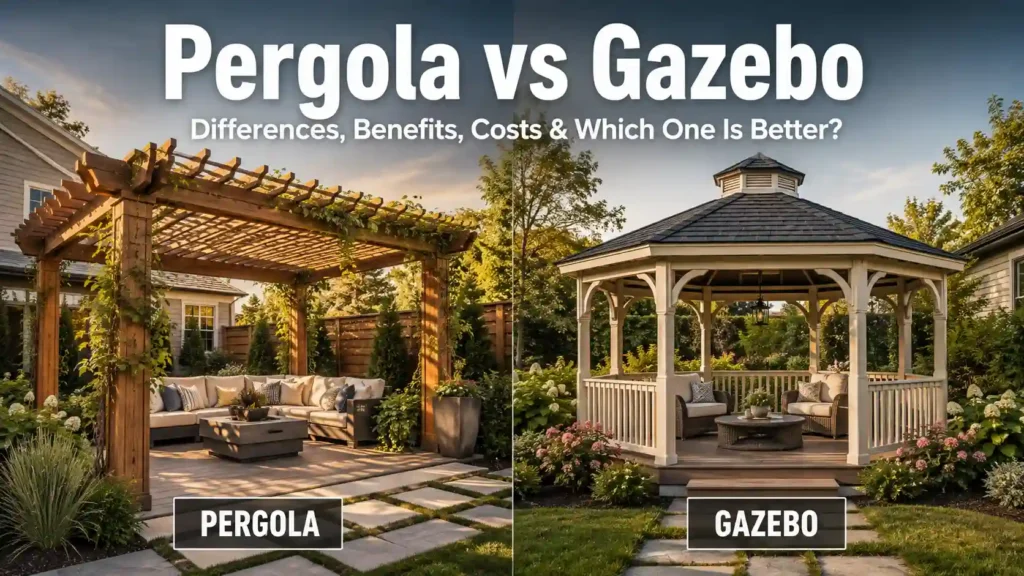
Pergola vs Gazebo: The Quick Answer
Choose a traditional pergola for an open feel and partial shade. Choose a gazebo with an opaque roof when steady overhead shade and rain cover matter most. Consider a louvered pergola if you want to adjust how much sun comes through.
Open sides still let in low sun and rain driven by wind. Neither name guarantees storm strength, privacy, or a set lifespan.
| Feature | Traditional open pergola | Louvered pergola | Gazebo with a solid roof |
|---|---|---|---|
| Roof | Spaced beams or slats | Slats that tilt or open | Continuous roof covering |
| Shade | Partial; changes with sun angle | Adjustable within the roof’s range | Steady overhead shade with an opaque roof |
| Rain cover | None through the open roof | Depends on closed roof, seals, and drains | Depends on sound roofing and drainage |
| Open view above | Yes, through the gaps | Depends on how the louvers open | Usually no |
| Moving roof parts | Usually none | Manual or powered parts | Usually none |
| Wind and snow strength | Check the exact model | Check the model and required roof position | Check the exact model |
| Privacy | Needs screens, plants, or panels | Needs suitable side features | Needs screens, curtains, or walls |
| Main appeal | Garden shade and an open frame | Control over sun and shade | A covered place to sit or dine |
What Is a Pergola?
A traditional pergola uses posts, beams, and spaced roof members. The gaps let light through, so the shade shifts as the sun moves.
Pergolas may stand on their own or form part of an approved design attached to a house. Some support climbing plants. Others have shade fabric or a sliding canopy.
A louvered pergola has a different roof. Its blades can turn to admit light or close to form a cover. Some use a hand crank or wand. Others use motors.
For example, Backyard Discovery’s Sarasota model has closing louvers and gutters that drain through the posts. That is a feature of that model, not a promise about every roof sold as a pergola.
What Is a Gazebo?
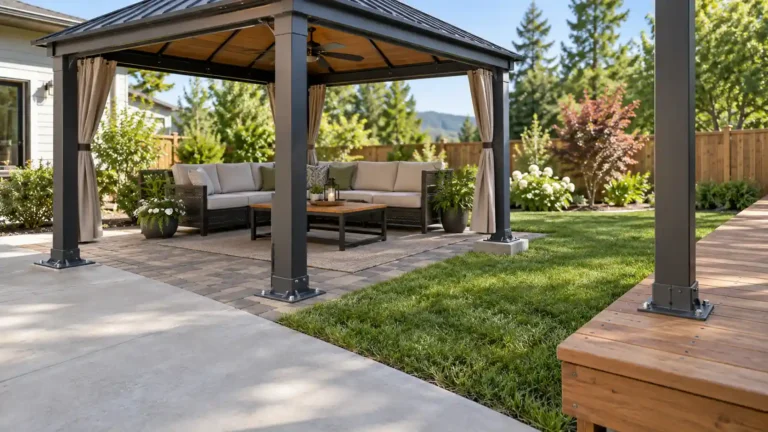
A gazebo is a roofed outdoor shelter. Many have open sides. Others add mesh screens, curtains, railings, or walls.
It can be square, rectangular, round, or have several sides. It does not need an eight-sided shape to count as a gazebo.
Common options include:
- Hardtop gazebos: Roofs made from metal, shingles, or other rigid materials.
- Fabric-top gazebos: A canopy stretched over a frame.
- Screened gazebos: Mesh around the sides to help keep insects out.
The frame and roof may use different materials. A wood gazebo can have a steel roof. A metal frame can carry a fabric top.
Check both parts when comparing care, weather limits, and replacement costs.
Which Gives Better Shade and Rain Cover?
Shade Depends on the Roof and the Sun
An open pergola creates bands of light and shade. The gap size, beam direction, and sun angle all affect where the shade falls.
Before buying, check the spot at the time you expect to use it. A layout that shades the table at noon may leave it in full sun later.
An opaque gazebo roof gives more complete cover from overhead sun. Low sun can still enter through open sides. A clear or translucent roof gives a different result, so check the roof material.
Louvers let you change the light above you. Side screens may help with low sun, but they must suit the structure and its wind limits.
Rain Cover Needs More Than a Roof Label
Rain passes through a traditional open pergola. Shade cloth should not be treated as a rainproof roof unless the maker rates it for that use.
A sound gazebo roof can keep ordinary rainfall off the area beneath it. Open sides still leave furniture exposed to rain blown in at an angle.
A louvered pergola can also manage rain when its roof is designed for it. Check the seals, gutters, outlet locations, and any limits on use. Keep drains clear.
Adding roof panels to an open pergola changes its weight and wind loads. Use a cover approved for that frame or have the change designed. Do not assume that spare sheets and screws make a suitable roof.
Which Is Better in Wind or Snow?
Neither a pergola nor a gazebo is automatically stronger because of its name or shape. The frame, joints, roof, anchors, and foundations must work together.
Wind: Compare the Published Conditions
An open roof changes how wind acts on a structure. That alone does not prove it can withstand stronger wind than a covered gazebo.
As one example, Backyard Discovery advertises wind resistance up to 100 mph for both its 12×12 Beaumont pergola and 12×12 Barrington gazebo. Both claims require anchoring as specified in the instructions.
Those are manufacturer claims for two products. They do not establish that every pergola and gazebo performs alike, or that either model meets the requirements for every site.
Before buying, ask:
- Which size and configuration does the rating cover?
- What anchors and foundations are required?
- Do curtains, screens, or added covers change the conditions?
- Does the seller provide the documents your local authority needs?
Moving roofs can have special rules. Renson, for example, describes controls that move a pergola and its screens to a safer position when wind rises. Follow the instructions for your model.
For the base connection, read our guide to anchoring a gazebo on concrete, pavers, grass, or a deck.
Snow: Check Load, Not Just Roof Pitch
A sloped roof does not prove that a gazebo can carry heavy snow. Snow can collect unevenly. Rain and ice can add weight.
FEMA’s snow guidance explains that roof shape, drifting, temperature changes, and rain on snow affect the load. A depth in inches alone does not tell the whole story.
Ask for the roof’s stated snow load and its conditions. Check whether the manual requires snow removal, canopy removal, or a certain louver position.
If the seller cannot provide clear snow guidance, ask for it before choosing the structure for winter use.
A backyard shelter’s load rating is also not a reason to stay beneath it during severe weather.
Pergola vs Gazebo Cost: Compare the Full Project
A simple open pergola can cost less than a gazebo of similar size. However, moving roofs, screens, custom work, and site preparation can change the result.
A claim that all pergolas cost less would be misleading. Compare specific designs with the same work included.
Manufacturer Price Examples
The following U.S. prices were displayed on the manufacturers’ direct product pages when checked on September 24, 2026.
| Backyard Discovery model | Roof type | Listed kit price | Optional assembly shown |
|---|---|---|---|
| 12×12 Beaumont Pergola | Open trellis | $1,799 | $650 |
| 12×10 Sarasota Steel Louvered Pergola | Adjustable louvers | $2,499 | $670 |
| 12×12 Barrington Gazebo | Fixed steel roof | $2,799 | $910 |
Sources: the manufacturer’s product pages for the Beaumont, Sarasota, and Barrington. Prices and offers can change.
The table gives product examples from one brand. It is not a national price average or a product ranking. The Sarasota is also a different nominal size.
The kit price excludes the optional assembly shown. Neither column is a full project quote. Confirm taxes, delivery terms, site work, and assembly scope for your address.
What Else Belongs in the Budget?
Ask for an itemized quote that covers:
- Ground preparation and drainage.
- Footings, a slab, or deck work.
- Anchors and other parts bought separately.
- Delivery access and assembly.
- Permits and design work where needed.
- Screens, curtains, gutters, or roof controls.
- Electrical work for fixed lights, fans, or motors.
- Ongoing finish care and replacement parts.
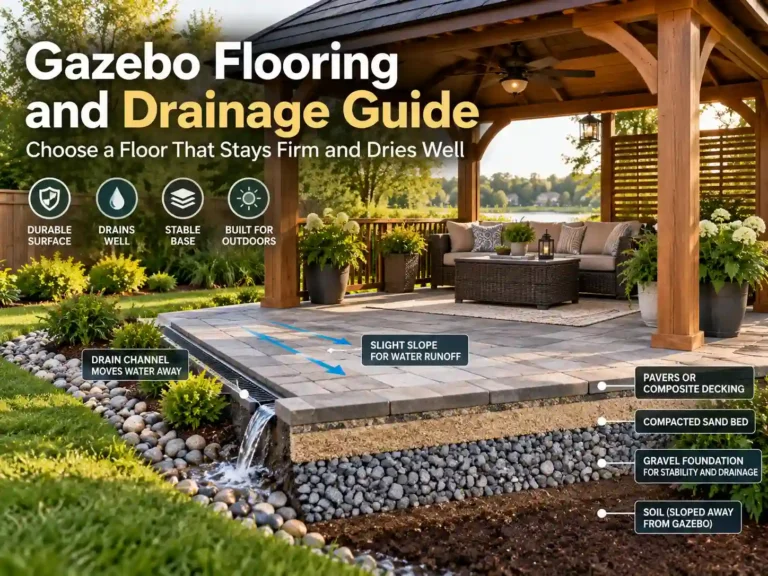
An existing patio does not prove that the supports are ready. Our gazebo foundation guide explains the difference between a finished floor and a structural base.
Which Needs Less Care or Lasts Longer?
The material, design, exposure, and upkeep matter more than the label.
An open pergola has fewer roof parts to clean than a louvered system. It still has joints, fasteners, and exposed surfaces to check. A gazebo adds roof seams, panels, or fabric that need care.
| Material or part | Care to plan for |
|---|---|
| Wood | Check for decay, splits, damp joints, and worn finishes |
| Coated steel | Inspect scratches, rust, fasteners, and places that hold water |
| Aluminum | Clean as directed; check finish damage, corrosion, and connections |
| Fabric canopy | Check seams, tears, tension, and weather-related removal rules |
| Louvers and motors | Keep drains clear and follow the service instructions |
| Roof panels or shingles | Inspect damage, joints, fasteners, and leaks |
Cedar’s natural properties do not remove the need for care. The Western Red Cedar Lumber Association explains that finish performance varies with exposure, surface preparation, and the product used. Follow the gazebo maker’s requirements as well.
Aluminum does not form red iron rust like steel. The Aluminum Association also notes that moisture can cause staining under some conditions. Cleaning and checks still matter.
There is no reliable lifespan to assign to every pergola or gazebo. Compare the warranty’s terms, spare-part support, and required upkeep. A warranty period is not a prediction of how long the whole structure will last.
Use our gazebo maintenance checklist to plan seasonal checks.
Which Size Will Fit Your Yard?
Start with the furniture and the space around it. A large yard can have a narrow usable patio. A small yard can have a well-placed seating area.
Check:
- The roof’s overall width and length.
- The clear space between the posts.
- Room to pull out chairs and reach each seat.
- Space for screens, doors, or curtains.
- Local placement limits and access for upkeep.
A size such as 12×12 may describe the outside dimensions. The room beneath the roof can be smaller.
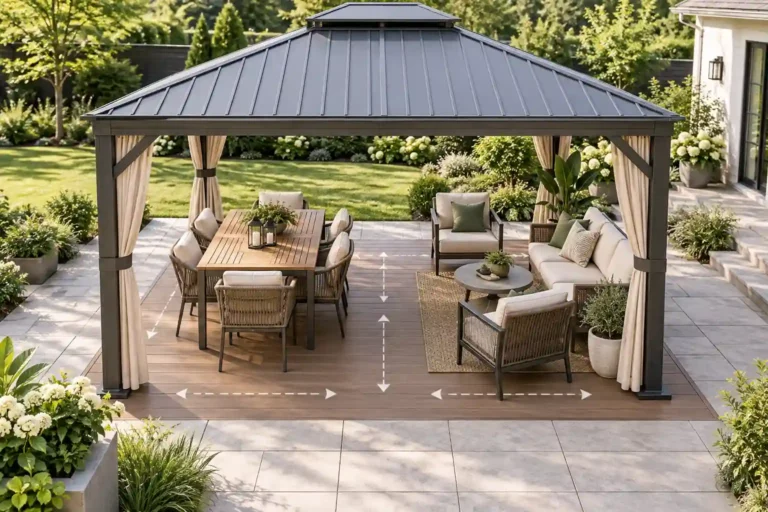
Mark the inside space on the ground. Set out chairs and walk through the entrance before you order. Our gazebo size and furniture layout guide gives measured layouts you can test.
Placement, Privacy, and Installation
Attached or Freestanding?
Both types need sound supports. A model designed to stand alone should not be fastened to the house without an approved design.
An attached structure needs suitable connections to the building. A roofed attachment also needs proper water management where it meets the wall.
Assembly time varies with the kit, crew, base, and access. Avoid judging the work by whether the product is called a pergola or gazebo.
Does a Gazebo Give More Privacy?
Only if its sides provide it. An open gazebo and an open pergola can both be seen from nearby homes.
Screens, curtains, plants, and panels may help. Check what the frame can support and how added sides affect its use in wind.
Can You Cook Beneath Either One?
An open pergola roof does not automatically make a grill safe below it. Follow the grill maker’s overhead and side clearance rules and the shelter’s instructions.
NFPA advises keeping grills away from the home and deck rails, and out from under eaves and overhanging branches. Plan the cooking area around the appliance’s requirements.
Do You Need a Permit?
Rules depend on the location and project. Size, height, placement, foundations, and electrical work may affect approval.
Ask the local building and planning offices before ordering. Even when a building permit is not required, placement rules may still apply. Check any HOA requirements too.
How to Choose for the Way You Use Your Yard
| Your main goal | A useful starting point |
|---|---|
| A garden feature with dappled shade | Traditional pergola |
| Adjustable sunlight over the seats | Louvered pergola |
| Steady overhead shade for a dining table | Gazebo with an opaque roof |
| Rain cover without a moving roof | Gazebo with suitable fixed roofing |
| A covered space with insect screens | Gazebo with a fitted screen system |
| Fewer roof mechanisms to maintain | Traditional pergola or fixed-roof gazebo |
| Use in a windy or snowy location | A model documented for the site’s requirements |
Choose the feature you will use most. Then check whether the exact product delivers it within your budget.
For example, a family that eats outside in mixed weather may value a fixed roof. Someone who wants winter sun and summer shade may prefer an adjustable roof. A gardener may be happy with an open frame and shifting shade.
Frequently Asked Questions
Is a pergola cheaper than a gazebo?
Sometimes. A basic open pergola may cost less, but size, materials, roof controls, labor, and site work can change the total. Compare full quotes for the designs you want.
Can a pergola keep rain out?
A traditional open roof cannot. A rated canopy or a designed louvered roof may provide rain cover. Check its limits, drainage, and installation requirements.
Is a gazebo better in high winds?
Not by default. Compare the exact model’s documentation, anchors, and foundation requirements. The roof style alone cannot settle the choice.
Which works better in a small yard?
Either can work. Measure the usable space, roof overhang, post positions, and access. Choose a layout that leaves room to use the furniture.
Will either structure increase home value?
Do not assume a set return. Buyer preferences, local demand, condition, and permitted work can affect its appeal. Choose it for the use you expect to get from the yard.
Conclusion
Choose a pergola if an open feel and changing shade suit your plans. Choose a gazebo if a covered place to sit and dine matters more. A louvered pergola can give you control over sun and shade, with more roof parts to maintain.
Before you buy, confirm the inside space, full installed cost, and weather requirements for the exact model. Read the roof and anchor instructions together.
The best choice is the one that fits your daily use, your site, and the care you are willing to give it. Make those choices first, and the style becomes much easier to pick.